
You probably know that if you put two magnets close to each other, they will either attract or repel each other depending on their orientation. You probably also know that a piece of iron will always be attracted to a magnet, regardless of orientation. So how does this work?
If you've read our explainer article about the inner workings of permanent magnets, you will know that permanent magnets and electromagnets generate exactly the same type of magnetic field. The direction of the field is determined by the spins and orbits of the electrons inside the permanent magnet (or the current in an electromagnet), giving the magnet two distinct ends, called the north pole and the south pole.
Magnetic Field Plots
If you were to draw some arrows in the direction of the field at a set of points at the north pole of a magnet, they would all point away from the magnet. As you follow these same lines, they would begin to spread out and curve toward the south pole, where they converge again. The resulting diagram is a magnetic field plot, where the lines go from north to south. The field strength is represented by the density of the lines.
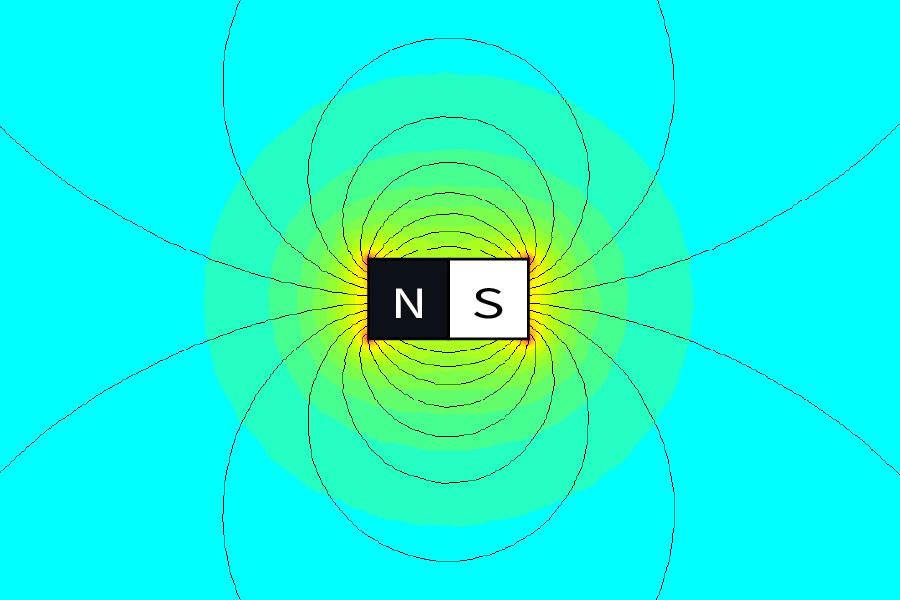 Magnetic field plot of a simple bar magnet
Magnetic field plot of a simple bar magnet
Magnetic Rules of Attraction
When you put two magnets close to each other, they interact. The rule is simple: opposite poles attract, and like poles repel. The stronger the field, the stronger the magnetic force.
When two magnets facing south-to-south are brought close to each other, they will repel. At the same time, they will try to rotate and align with each other's field, just like the compass needle aligns with the Earth's magnetic field. Once they are aligned, they will attract.
Fun fact: The north pole of a compass needle points toward the geographic north of the Earth because Earth's magnetic north pole is actually located near the geographic south pole.
Soft vs. Hard Magnetic Materials
When we speak about magnets and magnetic materials, the terms can get confusing. Permanent magnets – defined by their ability to retain their magnetism (magnetic retentivity and coercivity) – are known as hard magnetic materials. This includes neodymium (NdFeB), samarium cobalt (SmCo) and ferrites such as those in your common fridge magnet.
Soft magnetic materials on the other hand, are those that react to magnetic fields passively. They interact with the magnetic field because of a property called magnetic permeability, but they lack retentivity and coercivity, which means that they go back to normal once the field disappears. The most common type of soft magnetic material is iron and various ferrous steel alloys such as mild steel.
Why Magnets Always Attract Iron
Soft magnetic materials will always be attracted to a magnetic field, regardless of the orientation of the magnet. This happens because they respond to the magnetic field by aligning their internal electronic spins and orbits with it. It's like throwing a bag of miniature compass needles at another magnet. Each of those tiny magnets aligns with the field, causing the bag to stick to the larger magnet.
This is why Blumags' underwater magnets will always stick to a ship's hull, regardless of how you turn the magnet. The only criterion is that the ship is made of ferrous steel. Luckily, most ships are.